Find the best time for international meetings with our global time zone planner. Compare local times, working hours and DST across multiple locations. Select times or click locations directly on the map.
Click & Select
Click any country or city on the map to automatically populate host or participant time zones.
Hours Offset
Calculates exact differential hours ahead or behind host timezone for precise planning.
Waking Hours Check
Explicit hour indicators highlight business hours, early/late times, or typical sleeping hours.
How to Use the Global Meeting Timezone Planner
The Global Meeting Timezone Planner helps you find a suitable time for meetings involving people in different countries and time zones. Instead of manually calculating the local time for each participant, you can compare time zones and identify periods when everyone is likely to be available.
Start by selecting the locations or time zones of the people attending your meeting. The planner displays the corresponding local times, making it easier to see how a proposed meeting time affects participants in different parts of the world.
When choosing a meeting time, look for a period that falls within normal working hours for as many participants as possible. For example, a meeting between people in Ireland, New York and San Francisco may need to take place during the afternoon or early evening in Ireland to avoid an excessively early start on the US West Coast.
For meetings involving several countries, there may not be a perfect time for everyone. The aim is usually to find the fairest practical compromise, rather than a time that is ideal for only one location.
Before sending the invitation, check the date as well as the time. Daylight saving changes, large time differences and the International Date Line can sometimes mean that a meeting takes place on a different calendar day for participants in another part of the world.
Find the Best Time for an International Meeting
The best time for an international meeting is generally the period when the meeting falls within reasonable working hours for the largest number of participants.
A useful starting point is to consider 9:00 AM to 5:00 PM local time as a typical working day. This is only a guideline, however. Flexible working arrangements, different business practices and individual commitments mean that acceptable meeting hours can vary.
For example, consider a meeting involving Ireland, New York and San Francisco:
2:00 PM in Ireland may be 9:00 AM in New York and 6:00 AM in San Francisco.
4:00 PM in Ireland may be 11:00 AM in New York and 8:00 AM in San Francisco.
The second option is likely to be a more balanced choice because nobody has to attend particularly early or late.
When selecting a meeting time, consider:
The normal working hours of each participant.
Whether anyone would have to join unusually early or late.
Whether the meeting falls on the previous or following calendar day.
Daylight saving time in each location.
Whether the meeting schedule is fair if the same group meets regularly.
For recurring international meetings, consider rotating the meeting time so that the inconvenience does not always fall on the same participants.
Meeting Across Multiple Time Zones
Scheduling becomes more difficult as the number of time zones increases. A meeting involving two locations may have several convenient options, while a meeting involving North America, Europe, Asia and Australia can have very few.
For example, a meeting involving participants in Los Angeles, New York, London, Singapore and Sydney covers a large portion of the world's time zones. A time that is convenient for London may be very early in Los Angeles or late in Singapore.
When several time zones are involved, consider the following approaches:
Find a central compromise: Choose a time that is reasonably convenient for everyone, even if it is not perfect for anyone.
Rotate meeting times: Change the meeting time from week to week so that early mornings or late evenings are shared fairly.
Record meetings: If some participants cannot reasonably attend, provide a recording and written notes.
Use asynchronous communication: Documents, email, recorded updates and project-management tools can reduce the number of meetings that need to happen in real time.
The more time zones involved, the more important it becomes to consider fairness as well as convenience.
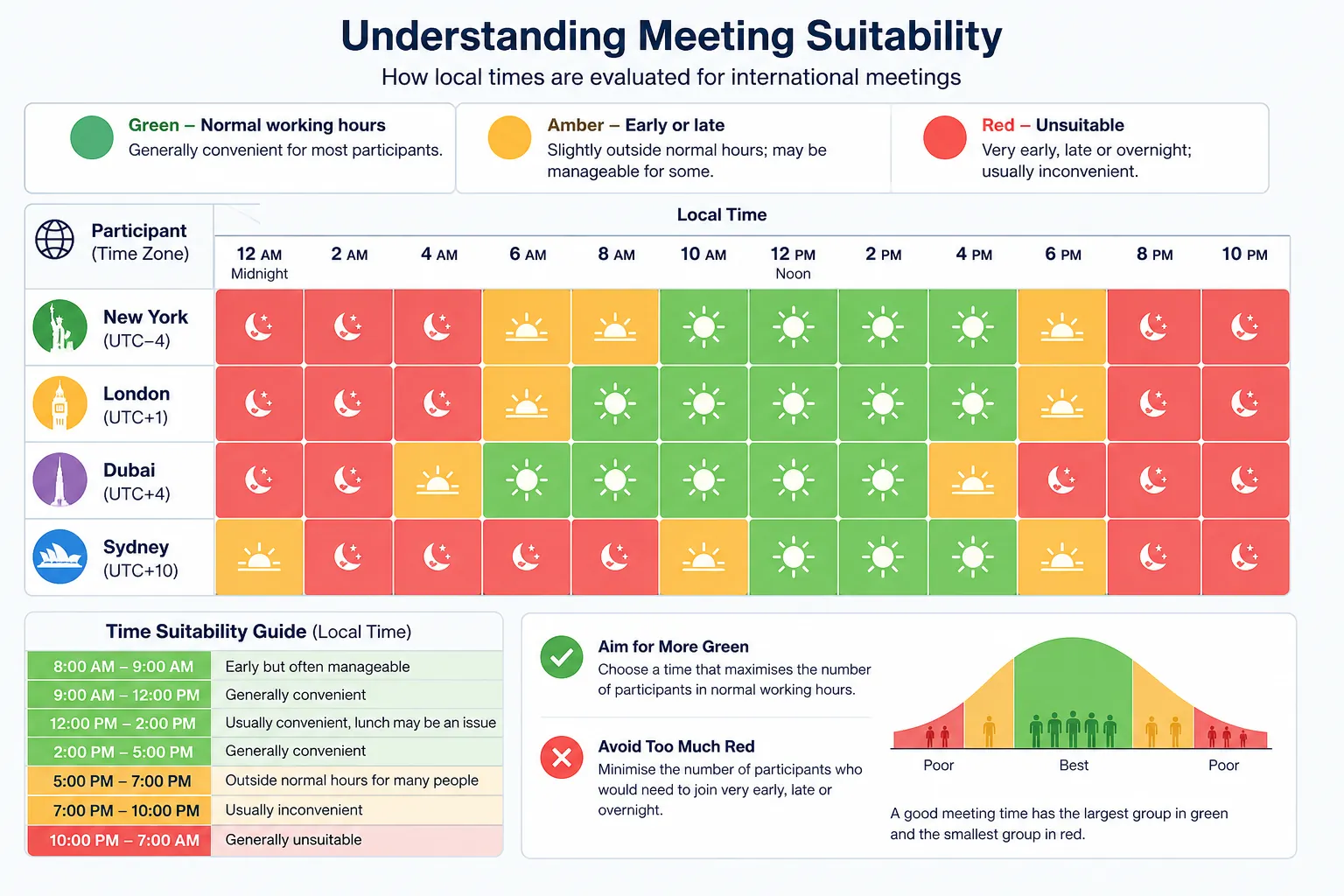
Understanding Meeting Suitability
A suitable meeting time depends on more than simply whether it falls between 9:00 AM and 5:00 PM. A time that is technically within working hours may still be inconvenient because of lunch breaks, commuting, childcare or other commitments.
The following provides a useful general guide:
Local Time
General Suitability
8:00 AM–9:00 AM
Early but often manageable
9:00 AM–12:00 PM
Generally convenient
12:00 PM–2:00 PM
Usually convenient, although lunch may be an issue
2:00 PM–5:00 PM
Generally convenient
5:00 PM–7:00 PM
Outside normal hours for many people
7:00 PM–10:00 PM
Usually inconvenient
10:00 PM–7:00 AM
Generally unsuitable
How local times are calculated for international meetings.
These times are only guidelines. Employees working flexible hours may be happy to attend meetings outside traditional office hours, while some organisations may have strict limits on when meetings can be scheduled.
For international meetings, it is useful to think in terms of three broad categories: green for normal working hours, amber for slightly early or late times, and red for very early morning, late evening or overnight meetings. A good meeting time normally maximises the number of participants in the green period while minimising the number in the red period.
Daylight Saving Time and International Meetings
Daylight saving time can make international meeting scheduling more complicated because clocks do not change at the same time everywhere, and some countries do not observe daylight saving time at all.
Ireland and much of Europe change their clocks seasonally, as do most parts of the United States. However, the dates on which clocks change are different. This means that the time difference between two locations can temporarily change during the periods between their respective clock changes.
Some locations, including many countries in Asia and Africa, do not use daylight saving time.
This is particularly important when arranging recurring meetings. A meeting that has a particular time difference between two locations at one point in the year may have a different local-time relationship after one location changes its clocks and the other has not.
The safest approach is to check the meeting time for the specific date, rather than relying on a fixed assumption such as "New York is always five hours behind Ireland."
The Global Meeting Timezone Planner can help you compare the local times for the date of your meeting and identify potential scheduling conflicts caused by seasonal clock changes.
Common International Meeting Time Zones
International meetings frequently involve a combination of major business centres across North America, Europe and Asia. Some commonly encountered time zones include:
UTC / GMT: Coordinated Universal Time is the main reference point used for global time calculations, while GMT is also used as a time zone designation.
Ireland / UK: UTC in winter and UTC+1 during daylight saving time.
Central European Time (CET): UTC+1 in winter and UTC+2 during daylight saving time.
Eastern Time (US/Canada): UTC-5 in standard time and UTC-4 during daylight saving time.
Central Time (US/Canada): UTC-6 in standard time and UTC-5 during daylight saving time.
Mountain Time (US/Canada): UTC-7 in standard time and UTC-6 during daylight saving time.
Pacific Time (US/Canada): UTC-8 in standard time and UTC-7 during daylight saving time.
India Standard Time (IST): UTC+5:30.
China Standard Time: UTC+8.
Japan Standard Time (JST): UTC+9.
Australian Eastern Time: Commonly UTC+10, with seasonal variations in some locations.
Time zone abbreviations can sometimes be confusing. For example, CST can refer to different time zones in different parts of the world. When arranging an international meeting, identifying the location or full time zone is often clearer than relying on an abbreviation alone.
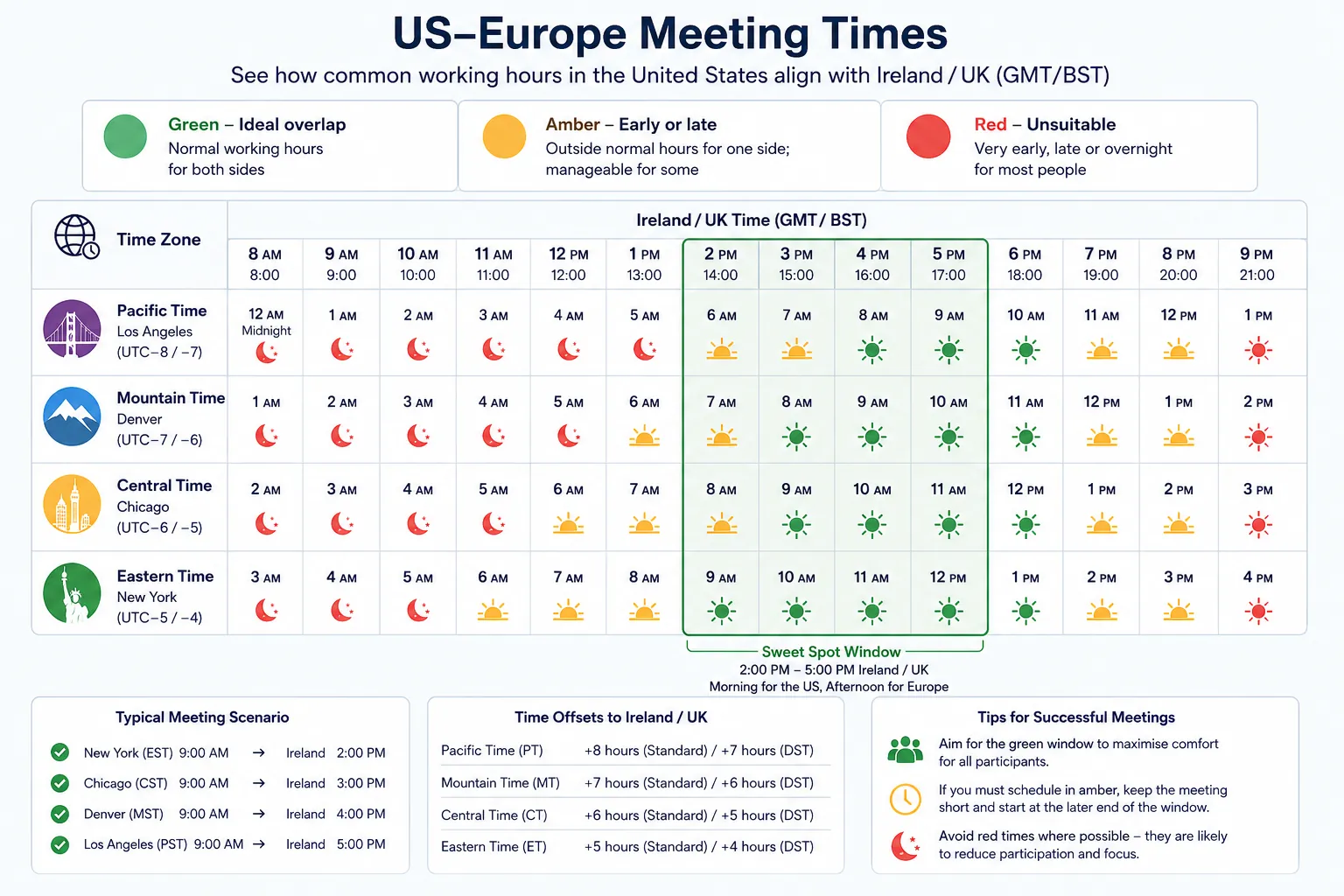
US–Europe Meeting Times
Meetings between the United States and Europe are common for international businesses, technology companies and distributed teams. Because Europe is several hours ahead of North America, a time that works well for European participants can be quite early for colleagues in the United States.
As an illustration, a morning meeting in the United States can correspond to the afternoon in Europe:
US Location
Example US Meeting Time
Example Ireland / UK Time
New York
9:00 AM
2:00 PM
Chicago
9:00 AM
3:00 PM
Denver
9:00 AM
4:00 PM
Los Angeles
9:00 AM
5:00 PM
US and Europe meeting times comparison.
Important: These example differences can change during periods when the United States and Europe change their clocks on different dates.
For US–Europe meetings, early afternoon in Europe often provides a useful compromise. This allows European participants to attend during their working day while giving participants in the eastern United States a reasonable morning start. Meetings involving the US West Coast and Europe may need to take place later in the European afternoon.
US–Asia Meeting Times
US–Asia meetings can be particularly challenging because of the large time difference. When it is daytime in the United States, it is often the following day in Asia.
For example, a meeting held at 9:00 AM in New York can take place in the evening in parts of Asia, while a 9:00 AM meeting in Tokyo can fall during the evening or night in the United States.
Potential approaches for US–Asia meetings include:
Early morning in the US: This can correspond to evening in Asia.
Late afternoon or evening in the US: This can correspond to morning in Asia on the following day.
Rotate meeting times: Share the inconvenience when the same teams meet regularly.
Use recordings and asynchronous updates: Useful when there is no reasonable overlap in working hours.
The most suitable option depends on the specific locations involved. The time difference between New York and Tokyo is different from the time difference between Los Angeles and Tokyo, so always check the actual locations rather than relying on a general US–Asia time difference.
Europe–Asia Meeting Times
Europe and Asia also have a substantial time difference, but there is often a useful overlap during the European morning and Asian afternoon or evening.
A meeting in the morning in Ireland or the UK may take place in the afternoon or evening in countries such as Singapore, China or Japan. This can make morning meetings in Europe a useful option for European–Asian teams.
However, the further east the Asian participant is located, the later it will be locally. A meeting that is comfortable for someone in India may be considerably later for someone in Japan or Australia.
For recurring meetings, consider alternating between European morning and European afternoon sessions where possible. This can distribute the inconvenience more fairly between teams and prevent one region from always having to attend at an inconvenient time.
Tips for Scheduling Global Meetings
Scheduling across time zones does not have to be complicated if you establish a consistent process. The following tips can help you organise meetings that are more convenient and fair for international participants.
Check the local time for everyone: Never assume that you know the time difference. Check the actual date and locations involved, particularly around daylight saving changes.
Avoid extremely early and late meetings: Try to keep meetings within reasonable waking and working hours. An occasional early or late meeting may be acceptable, but it should not become the default for the same people.
Consider the calendar date: Participants in Asia or Australia may be attending on the following calendar day compared with colleagues in Europe or North America.
Rotate inconvenient times: If there is no perfect time, rotate the meeting schedule so that the same people are not always required to attend early in the morning or late at night.
Put the time zone in the invitation: Rather than writing only "3:00 PM", specify the location or time zone as well. This reduces the risk of misunderstandings.
Use calendar software that converts times automatically: Modern calendar applications can display meeting times in participants' local time zones. It is still worth checking the invitation before sending it.
Think about lunch and commuting hours: A meeting at 12:30 PM may coincide with lunch, while a 5:00 PM meeting may overlap with commuting or other personal commitments.
Keep recurring meetings under review: A recurring meeting can become inconvenient after daylight saving changes. Check the schedule periodically rather than assuming that the same UTC offset applies throughout the year.
Use asynchronous communication where appropriate: If a meeting requires participants to join at unreasonable times, consider whether the discussion could instead be handled through email, shared documents, recorded presentations or project-management software.
Aim for fairness: For genuinely global teams, there may be no perfect meeting time. The fairest solution is often to share the inconvenience rather than repeatedly asking the same region to attend early or late.
Global Meeting Timezone Planner FAQ
What is a global meeting timezone planner?
A global meeting timezone planner is a tool that helps you compare local times in different locations when arranging meetings between people in different countries or time zones. It makes it easier to identify periods when participants are likely to be available.
How do I find a suitable time for an international meeting?
Select the locations or time zones of the meeting participants and compare their local times. Look for a period that falls within reasonable working hours for as many participants as possible. If there is no ideal time, choose the fairest practical compromise.
What is the best time for a meeting across multiple time zones?
There is no universal best time. The ideal meeting time depends on the locations involved. For teams spread across Europe, North America and Asia, it may be necessary to compromise or rotate meeting times.
How do I schedule a meeting between Europe and the United States?
Early afternoon in Europe often works well because it generally corresponds to morning in the eastern United States. Meetings involving the US West Coast may need to take place later in the European afternoon.
How do I schedule a meeting between the US and Asia?
US–Asia meetings often require a compromise because of the large time difference. An early morning meeting in the US can correspond to evening in Asia, while an evening meeting in the US may correspond to the following morning in Asia.
How does daylight saving time affect international meetings?
Daylight saving time can change the time difference between locations during parts of the year. Different countries may change their clocks on different dates, while some countries do not observe daylight saving time at all. Always check the actual date of a meeting rather than relying on a fixed time difference.
Can a meeting be on different dates in different countries?
Yes. Because of large time differences and the International Date Line, a meeting can occur on Monday in one location and Tuesday in another. This is particularly important when scheduling meetings between North America and Asia or Australia.
What is the best time zone to use when scheduling an international meeting?
There is no single best time zone. It is generally better to specify the meeting time using a location or recognised time zone and allow calendar software to display the equivalent local time for each participant.
Should international meetings be rotated?
Rotating meeting times can be a fair approach when participants are spread across widely separated time zones. It prevents the same group from continually having to attend meetings very early in the morning or late at night.
How can I make global meetings more convenient?
Keep meetings as close as possible to normal working hours, check daylight saving changes, include the time zone in invitations, consider participants' different working patterns, and use asynchronous communication when a reasonable meeting time cannot be found.